Biodata for Marriage · Custom software · Web application · Website development
A multilingual publishing product built to rank, convert, and grow.
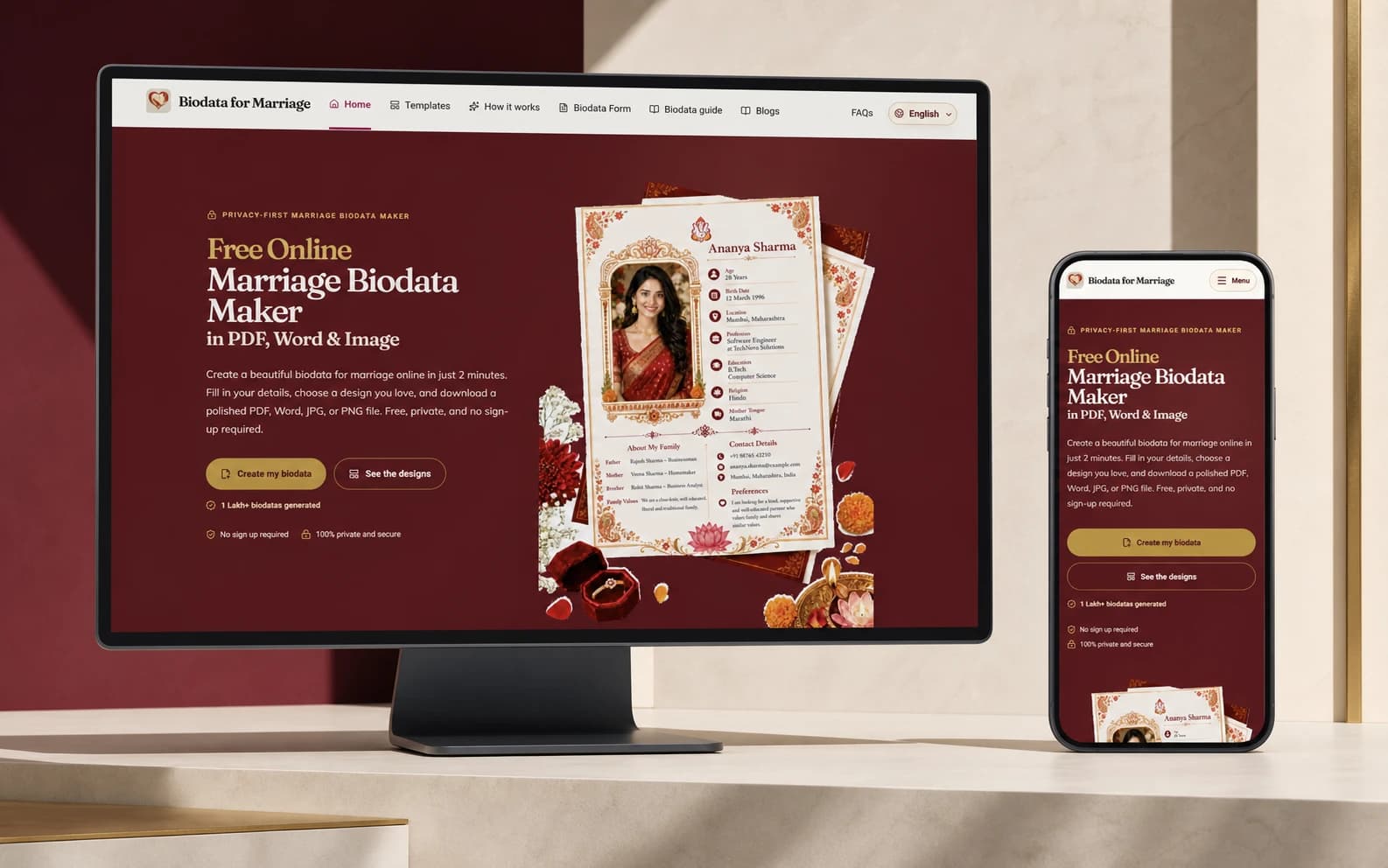
We created Biodata for Marriage as more than a template website. It is a complete publishing product: people enter their details once, choose from 50+ designs, and export a finished marriage biodata in PDF, Word, JPG, or PNG. The experience is private, works without sign-up, supports English, Hindi, and Marathi, and was engineered to earn organic demand rather than depend on paid acquisition alone.
100K+biodatas createdDelivered in under one month · 50+ templates · Four export formats · Three languages
- Timeline
- Under one month
- Templates
- 50+ designs
- Languages
- English · Hindi · Marathi
Summary
From blank page to 100K+ biodatas in under a month
We designed and built a privacy-first marriage biodata platform with 50+ templates, English, Hindi, and Marathi localization, and exports to PDF, Word, JPG, and PNG. Delivered in under a month, the product has supported 100K+ biodata creations.
100K+ biodatas created · Delivered in under one month · English, Hindi, and Marathi
The opportunity
Most marriage biodata tools solve only the last step: generating a document.
The larger opportunity was to build a self-sufficient product around the whole journey, from the first search to a polished file someone can share with a family.
That meant the product had to do several jobs at once. It needed to be simple for a first-time visitor, flexible enough for regional expectations, fast on everyday mobile connections, discoverable across search engines, measurable after launch, and efficient to operate as new search demand emerged.
The product system
We built one guided flow around a clear user job.
Enter personal and family details, select a design, preview the result, and download it in the format needed. The system includes:
- Templates
- 50+ marriage biodata templates with distinct visual styles
- Localization
- English, Hindi, and Marathi localization
- Exports
- PDF, Word, JPG, and PNG exports
- Workflow
- A form-to-preview workflow designed for mobile and desktop
- Privacy
- Browser-based, privacy-first use without mandatory registration
- Structure
- Reusable page and content structures that can expand without fragmenting the product
The benefit is straightforward: users do not need design software, document formatting skills, or a separate conversion tool. One product takes them from blank page to a finished biodata.
Localization beyond translated labels
Hindi and Marathi were treated as product languages, not text overlays.
Form labels, content hierarchy, typography, spacing, template rendering, and exported documents all had to remain usable when scripts and line lengths changed.
This made localization part of the interface and document-generation system. The result is a consistent creation flow across three languages without forcing regional users into an English-first experience.
Search engineered into the product
The site was designed to create its own acquisition channel.
Before shaping the information architecture, we used DataForSEO to examine keyword demand, difficulty, live result pages, competitors, traffic patterns, and backlink profiles across India, the United States, and global markets. That research informed the site structure and the on-page system:
Clear H1, H2, and H3 hierarchy
Page-specific titles and metadata
Breadcrumb navigation and structured internal paths
JSON-LD structured data
An llms.txt file and machine-readable content structure
IndexNow support alongside Google and Bing webmaster tooling
Technical and content decisions designed for conventional search, AI search, and agentic browsing
The aim was not to manufacture pages around keywords. It was to make every useful page understandable to people, search engines, and machine-led discovery systems.
A demand-led editorial engine
The product also includes an AI-assisted publishing workflow designed to create useful articles where real demand exists.
Topic inputs come from questions and search behavior observed across Google, Bing, and Reddit.
Each article moves through a nine-plus-stage process. Research, intent, outline, drafting, factual and structural review, search alignment, quality evaluation, and correction happen as separate steps. Feedback from each evaluation is applied before the article advances.
This creates a repeatable weekly publishing system without accepting thin, generic, or developer-focused content. Articles are written for prospective users and clients, and only where the evidence shows a real question to answer.
Performance and quality
Speed was treated as product behavior, not a launch checklist item.
Owner-recorded repeat audits across the site report:
- Lighthouse performance
- 95 to 100
- Accessibility
- 100
- Best practices
- 100
- SEO
- 100
- Agentic browsing
- 3/3
Measurement and distribution
The launch stack connects product behavior with search visibility.
Microsoft Clarity supports session insight, Google Analytics measures usage, Google Search Console and Bing Webmaster Tools expose search performance, and IndexNow helps communicate content changes to supported search engines.
Together, these tools make the product observable after release. The team can see what attracts visitors, where people struggle, what begins to rank, and which topics deserve further investment.
Outcome
100K+ biodatas created.
The platform was delivered in under one month and has supported 100K+ biodata creations. Within the first seven days, relevant keywords had begun to rank and the site had started receiving clicks.
The deeper result is the operating model behind those numbers: a fast, localized product with its own search architecture, analytics, publishing workflow, and content feedback loop. It was built not only to launch, but to keep earning relevance after launch.
Biodata for Marriage shows what happens when product engineering, interface design, localization, technical SEO, analytics, and content operations are designed as one system. In under a month, UnicornX turned a familiar document task into a fast, multilingual product capable of attracting demand and generating value on its own.
Technology Next.js · Tailwind CSS · Vercel · Microsoft Clarity · Google Analytics · Google Search Console · Bing Webmaster Tools · IndexNow · DataForSEO
More selected work